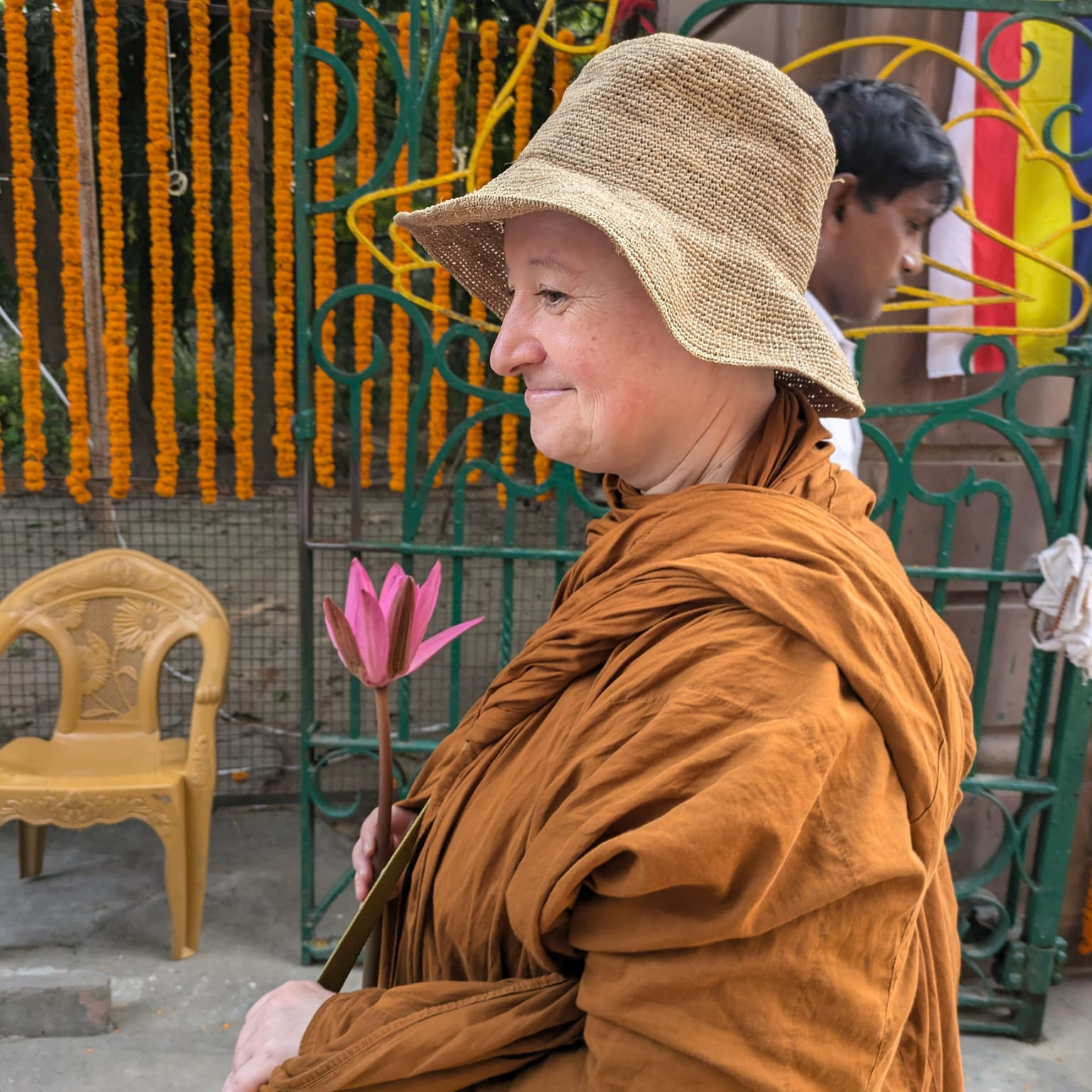
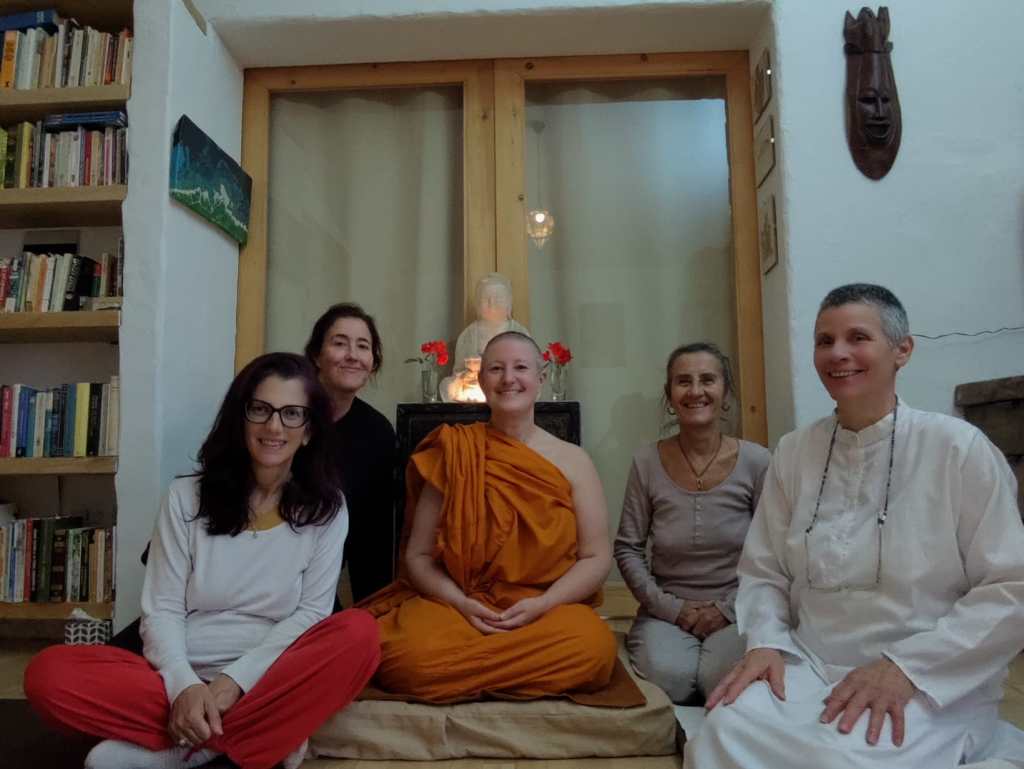
Mit viel Freude und auch einer ordentlichen Portion Nervosität hielt ich am Wochenende vom 14. – 16. November mein erstes englischsprachiges Retreat. In ihrem kleinen Retreatzentrum Karuna Vana in Sardinien umsorgte uns Kamala ebenso liebevoll wie aufmerksam. Von Freitagabend bis Sonntagnachmittag erläuterte ich der kleinen Gruppe die Methode, nach der ich praktiziere und es bot sich jede Menge Gelegenheit sie im Gehen und Sitzen zu üben. Doch auch in den Pausen nutzen wir alle Möglichkeiten, sowohl unsere Achtsamkeit und Bewusstheit zu schulen als auch unser Herz mit Freude, Wertschätzung und Dankbarkeit zu füllen.
Sehr gerne teile ich hier den Vortrag, den ich gehalten habe:
In dem Video sind jetzt auch Untertitel verfügbar. In deutsch, italienisch, spanisch, französisch, thai und singhalesisch. Gebt mir einfach kurz Bescheid, falls ich noch eine Sprache hinzufügen soll.
Ebenso den Text, mit dem ich mich vorbereitet habe. In deutsch, englisch und italienisch. Ganz zum Schluss möchte ich auch den Text mit euch teilen, mit dem wir unsere Herzen in der Mittagspause auf mehr Freude und Wertschätzung ausgerichtet haben.
Ich wünsche euch viel Freude und Inspiration beim Lesen!
Die vier edlen Wahrheiten
The four noble truths
Le quattro nobili verità
Wir alle möchten uns wohlfühlen und glücklich sein. Alles, was wir tun, dient schlussendlich dem Zweck, uns wohl zu fühlen. Wir gehen zur Arbeit, um Geld zu verdienen, um Dinge zu bezahlen, die für unser Wohlbefinden sorgen sollen. Wir pflegen Hobbies und soziale Kontakte, um uns wohl zu fühlen. Wir streben nach Bestätigung und Anerkennung, um uns wohl zu fühlen. Wir tun, was wir können, um zu vermeiden, uns unwohl zu fühlen.
We all want to feel good and be happy. Everything we do ultimately serves the purpose of making us feel good. We go to work to earn money to pay for things that are supposed to ensure our well-being. We pursue hobbies and socialize to feel good. We strive for validation and recognition to feel good. We do what we can to avoid feeling uncomfortable.
Tutti noi desideriamo stare bene ed essere felici. Tutto ciò che facciamo, in fin dei conti, ha lo scopo di farci stare bene. Andiamo al lavoro per guadagnare denaro, per pagare le cose che ci garantiscono il benessere. Coltiviamo hobby e relazioni sociali per stare bene. Cerchiamo approvazione e riconoscimento per sentirci bene. Facciamo tutto il possibile per evitare di sentirci a disagio.
Sehr oft sind wir mit diesen Bemühungen erfolgreich. Aber nicht immer. Und niemals dauerhaft. Denn alles unterliegt der Veränderlichkeit: die Dinge verändern sich und kommen zu einem Ende.
Wenn wir damit scheitern, für unser Wohlbefinden zu sorgen, sind wir unglücklich und leiden.
Very often, we are successful in these efforts. But not always. And never permanently. Because everything is subject to impermanence: things change and come to an end.
When we fail to ensure our own well-being, we are unhappy and suffer.
Molto spesso questi sforzi hanno successo. Ma non sempre. E mai in modo duraturo. Perché tutto è soggetto all’impermanenza: le cose cambiano e giungono al termine.
Quando falliamo nel garantire il nostro benessere, siamo infelici e soffriamo.
Der Gedanke, seinen Sohn nicht vor Leid bewahren zu können, schmerzte den Buddha so sehr, dass er seine Familie verließ, um einen Weg zu finden, dem Leiden zu entgehen.
The thought of not being able to protect his son from suffering pained the Buddha so much that he left his family to find a way to escape suffering.
Il pensiero di non poter proteggere suo figlio dal malessere addolorava così tanto il Buddha che lasciò la sua famiglia per trovare un modo per sfuggire alla sofferenza.
In der Nacht seiner Erleuchtung erkannte der Buddha, wie dem Leiden ein für alle Mal ein Ende bereitet werden kann. Er formulierte die vier Edlen Wahrheiten, welche das Problem, seine Ursache und seine Behebung beschreiben.
On the night of his enlightenment, the Buddha realized how suffering could be ended once and for all. He formulated the Four Noble Truths, which describe the problem, its cause, and its solution.
Nella notte della sua illuminazione, il Buddha comprese come porre fine alla sofferenza una volta per tutte. Formulò le Quattro Nobili Verità, che descrivono il problema, la sua causa e la sua soluzione.
Die vier Edlen Wahrheiten sind kein philosophisches Konstrukt, über das sich mit anderen diskutieren lässt, aber mit unserem alltäglichen Leben nichts zu tun hat. Sondern es sind praktische Anleitungen, wie wir uns täglich, ja von Minute zu Minute, Schritt für Schritt von allem, was uns unglücklich macht, befreien können.
The Four Noble Truths are not a philosophical construct that can be discussed with others but has nothing to do with our everyday lives. Rather, they are practical instructions on how we can free ourselves from everything that makes us unhappy, day by day, minute by minute, step by step.
Le Quattro Nobili Verità non sono un costrutto filosofico di cui discutere con gli altri, ma che non ha nulla a che vedere con la nostra vita quotidiana. Sono piuttosto istruzioni pratiche su come liberarci ogni giorno, ogni minuto, passo dopo passo, da tutto ciò che ci rende infelici.
Die erste edle Wahrheit: Die Wahrheit vom Leiden
The first noble truth: The truth of suffering
La prima nobile verità: la verità della sofferenza
Der Erhabene sprach:
„Dies nun, ihr Mönche, ist die edle Wahrheit vom Leiden: Geburt ist Leiden, Alter ist Leiden, Krankheit ist Leiden, Sterben ist Leiden, Kummer, Jammer, Schmerz, Trübsinn und Verzweiflung sind Leiden; vereint sein mit Unliebem ist Leiden, getrennt sein von Liebem ist Leiden; was man verlangt, nicht erlangen, ist Leiden. Kurz gesagt: die fünf Faktoren des Ergreifens sind Leiden.
Diese edle Wahrheit vom Leiden ist zu durchschauen.“
The Blessed One said:
„This, monks, is the noble truth of suffering: birth is suffering, aging is suffering, illness is suffering, death is suffering, sorrow, lamentation, pain, grief, and despair are suffering; association with the unpleasant is suffering, separation from the pleasant is suffering; not getting what one desires is suffering. In short, the five factors of clinging are suffering.
This noble truth of suffering is to be understood.“
Il Sublime disse:
„Questa, monaci, è la nobile verità della sofferenza: la nascita è sofferenza, la vecchiaia è sofferenza, la malattia è sofferenza, la morte è sofferenza, il dolore, l’angoscia, la tristezza e la disperazione sono sofferenza; essere uniti a ciò che non si ama è sofferenza, essere separati da ciò che si ama è sofferenza; non ottenere ciò che si desidera è sofferenza. In breve: i cinque fattori dell’attaccamento sono sofferenza.
Questa nobile verità della sofferenza deve essere compresa.“
In der ersten Edlen Wahrheit fordert uns der Buddha auf, das Leiden zu untersuchen, bis wir es ganz genau verstanden haben.
Wenn wir mit Unangenehmem konfrontiert sind, neigen wir dazu, dem Unangenehmen auszuweichen oder es loswerden zu wollen.
Wir wollen es nicht haben und wir wollen es uns schon gar nicht anschauen.
Wenn wir es schon nicht vermeiden oder loswerden können, so wollen wir es wenigstens nicht wahrnehmen. Indem wir uns ablenken.
In the First Noble Truth, the Buddha urges us to examine suffering until we understand it completely.
When confronted with unpleasantness, we tend to avoid it or want to get rid of it.
We don’t want it, and we certainly don’t want to look at it.
If we cannot avoid or get rid of it, we at least want to ignore it. By distracting ourselves.
Nella prima Nobile Verità, il Buddha ci esorta a esaminare la sofferenza fino a comprenderla appieno.
Quando ci troviamo di fronte a qualcosa di spiacevole, tendiamo a evitarlo o a volerlo eliminare.
Non lo vogliamo e non vogliamo nemmeno guardarlo.
Se non possiamo evitarlo o liberarcene, almeno non vogliamo percepirlo. Distraendoci.
Wir alle sind Weltmeister darin, uns abzulenken. Handy, soziale Medien, Fernseher, Radio, Musik, Romane, sich mit Freunden treffen. Häufig dient Unterhaltung lediglich dem Zweck, uns von dem abzulenken, was sich nicht gut anfühlt.
We are all world champions at distracting ourselves. Cell phones, social media, television, radio, music, novels, meeting up with friends. Often, entertainment serves only to distract us from what doesn’t feel good.
Siamo tutti campioni nel distrarci. Cellulari, social media, televisione, radio, musica, romanzi, incontri con gli amici. Spesso l’intrattenimento serve solo allo scopo di distrarci da ciò che non ci fa stare bene.
Unser Umgang mit Unangenehmem beschränkt sich auf drei Strategien:
Es zu vermeiden.
Es loszuwerden.
Es zu ignorieren.
Our approach to unpleasant situations is limited to three strategies:
Avoiding them.
Getting rid of them.
Ignoring them.
Il nostro approccio alle situazioni spiacevoli si limita a tre strategie:
Evitarle.
Eliminarle.
Ignorarle.
Leider funktioniert keine dieser Methoden dauerhaft.
Weder können wir es immer vermeiden, noch immer loswerden. Und es zu ignorieren, funktioniert ebenfalls nur eine gewisse Zeit, bis es uns wieder einholt. Häufig stärker als zuvor.
Unfortunately, none of these methods work permanently.
We can neither always avoid it nor get rid of it. And ignoring it only works for a certain amount of time until it catches up with us again. Often stronger than before.
Purtroppo nessuno di questi metodi funziona in modo duraturo.
Non possiamo né evitarlo sempre, né liberarcene definitivamente. E ignorarlo funziona solo per un certo periodo, finché non ci raggiunge di nuovo. Spesso in modo più forte di prima.
Wir sehen in unserem Umfeld und in der Welt, dass es nicht funktioniert. Trotzdem versuchen wir es weiter. Wenn wir es geschickter anstellen und uns noch mehr bemühen, dann werden wir das Unangenehme los. Darum gibt es so viel Gewalt und Rücksichtslosigkeit auf der Welt. Weil alle noch härter versuchen, das Unangenehme von sich fernzuhalten.
We see in our environment and in the world that it doesn’t work. Nevertheless, we keep trying. If we do it more skillfully and try even harder, we will get rid of the unpleasantness. That is why there is so much violence and ruthlessness in the world. Because everyone is trying even harder to keep the unpleasantness away from themselves.
Nel nostro ambiente e nel mondo vediamo che non funziona. Ciononostante continuiamo a provarci. Se agiamo con più abilità e ci impegniamo ancora di più, riusciremo a liberarci di ciò che è sgradevole. Ecco perché nel mondo c’è tanta violenza e tanta mancanza di rispetto. Perché tutti cercano con ancora più forza di tenere lontano da sé ciò che è sgradevole.
Der Buddha rät uns, statt das Unangenehme vermeiden oder loswerden zu wollen, es zu untersuchen. Es zu verstehen. Es so lange zu beobachten, bis wir verstehen, was eigentlich das Problem ist.
Im englischen heißt verstehen understand. Also stand under, darunter stehen. Wir sollten mal so richtig in das Unangenehme hineintreten, uns darunter stellen, so dass wir alle seine Aspekte ergreifen und untersuchen können. Was ist daran eigentlich so schlimm, dass wir es um jeden Preis vermeiden wollen?
The Buddha advises us not to try to avoid or get rid of unpleasant things, but to examine them. To understand them. To observe them until we understand what the problem actually is.
The word understand tells uns to stand under. To stand beneath. We should really step into the unpleasantness and stand beneath it so that we can grasp and examine all its aspects. What is so bad about it that we want to avoid it at all costs?
Il Buddha ci consiglia, invece di evitare o cercare di liberarci delle cose spiacevoli, di esaminarle. Di comprenderle. Di osservarle finché non capiamo qual è il vero problema.
In inglese, capire si dice understand. Quindi stand under, stare sotto. Dovremmo affrontare davvero ciò che è sgradevole, metterci sotto, in modo da poter cogliere ed esaminare tutti i suoi aspetti. Cosa c’è di così terribile in esso da volerlo evitare a tutti i costi?
Wenn wir untersuchen, was daran eigentlich so furchtbar schlimm ist, werden wir feststellen, dass es gar nicht so schlimm ist. Dass wir viel mehr aushalten können als wir denken. Dadurch verlieren wir die Angst vor dem Unangenehmen. Was uns hilft, es noch genauer und tiefer zu untersuchen und zu verstehen. Bis wir verstehen, dass Dukkha nicht unser Feind, sondern unser bester Freund ist. Es zeigt uns nämlich, wie wir uns selbst unglücklich machen. Nicht um uns zu schaden. Im Gegenteil. Damit wir endlich damit aufhören.
When we examine what is actually so terrible about it, we realize that it is not so bad after all. That we can endure much more than we think. This helps us lose our fear of unpleasantness. This helps us to examine and understand it even more closely and deeply. Until we understand that dukkha is not our enemy, but our best friend. It shows us how we make ourselves unhappy. Not to harm us. On the contrary. So that we finally stop doing so.
Se analizziamo cosa c’è di così terribile in questo, ci rendiamo conto che non è poi così grave. Che possiamo sopportare molto più di quanto pensiamo. In questo modo perdiamo la paura delle cose spiacevoli. Questo ci aiuta ad analizzarlo e comprenderlo in modo ancora più accurato e approfondito. Finché non capiamo che il dukkha non è nostro nemico, ma il nostro migliore amico. Ci mostra infatti come rendiamo noi stessi infelici. Non per farci del male. Al contrario. Affinché smettiamo finalmente di farlo.
Die zweite edle Wahrheit: Die Wahrheit vom Ursprung des Leidens
The second noble truth: The truth of the origin of suffering
La seconda nobile verità: la verità sull’origine della sofferenza
Der Erhabene sprach:
„Dies, Mönche, ist die edle Wahrheit vom Ursprung des Leidens: Es ist dieses Verlangen, das die Wiedergeburt sät, das mit Befriedigung verbunden ist, das sich hier und dort erfreut, nämlich der Durst nach Sinneskontakten, der Durst nach Existenz, der Durst nach Nicht-Existenz.
Diese edle Wahrheit vom Ursprung des Leidens muss überwunden werden.“
The Blessed One said:
„This, monks, is the noble truth of the origin of suffering: it is this thirst that sows rebirth, that is bound up with satisfaction, that delights here and there, namely, thirst for sensory contact, thirst for existence, thirst for non-existence.
This noble truth of the origin of suffering is to be overcome.“
Il Sublime disse:
„Questa, monaci, è la nobile verità sull’origine della sofferenza: è questo desiderio che semina la rinascita, che è legato alla soddisfazione, che gode qui e là, cioè la sete dei contatti sensoriali, la sete dell’esistenza, la sete della non esistenza.
Questa nobile verità sull’origine della sofferenza deve essere superata.“
Die Ursache für unser Leiden sind nämlich nicht die unangenehmen Dinge oder Menschen oder Situationen. Die Ursache liegt in unserem Wünschen. Wir wollen mit unseren Sinnen Angenehmes erfahren. Schöne Bilder sehen, schöne Töne hören, gute Düfte riechen, Schmackhaftes schmecken, mit dem Körper Angenehmes fühlen und vor allem all das mit unserem Geist verarbeiten und wiederholen.
Wir ziehen es sogar vor, Unangenehmes zu erleben, als gar nichts zu erleben.
The cause of our suffering is not unpleasant things, people, or situations. The cause lies in our desires. We want to experience pleasant things with our senses. We want to see beautiful images, hear beautiful sounds, smell pleasant scents, taste delicious flavors, feel pleasant sensations with our bodies, and above all, process and repeat all of this with our minds.
We even prefer to experience unpleasant things rather than experience nothing at all.
La causa della nostra sofferenza non sono infatti le cose, le persone o le situazioni spiacevoli. La causa risiede nei nostri desideri. Vogliamo provare sensazioni piacevoli con i nostri sensi. Vedere immagini belle, ascoltare suoni piacevoli, sentire profumi gradevoli, assaporare cibi gustosi, provare sensazioni piacevoli con il corpo e, soprattutto, elaborare e ripetere tutto questo con la nostra mente.
Preferiamo persino provare sensazioni spiacevoli piuttosto che non provare nulla.
Des weiteren wollen wir unbedingt etwas sein. Was wir sein wollen, unterscheidet sich von Person zu Person.
Manche wollen gute Menschen sein. Andere wollen clevere Menschen sein. Manche wollen schön sein, erfolgreich sein, gebildet sein, beliebt sein, mächtig sein, …. es gibt unendlich viele Möglichkeiten und Kombinationen, was man alles sein wollen kann.
Furthermore, we definitely want to be something. What we want to be differs from person to person.
Some want to be good people. Others want to be clever people. Some want to be beautiful, successful, educated, popular, powerful… there are endless possibilities and combinations of what one can want to be.
Inoltre, vogliamo assolutamente essere qualcosa. Ciò che vogliamo essere varia da persona a persona.
Alcuni vogliono essere brave persone. Altri vogliono essere persone intelligenti. Alcuni vogliono essere belli, avere successo, essere colti, essere popolari, essere potenti… Ci sono infinite possibilità e combinazioni di ciò che si può desiderare di essere.
Oft wünschen wir uns auch, anders zu sein als wir sind. Manchmal sogar, gar nicht zu sein. Besonders, wenn die Dinge schief laufen, wenn wir keine Möglichkeit sehen, unsere Wünsche zu befriedigen.
We often wish we were different from who we are. Sometimes we even wish we didn’t exist at all. Especially when things go wrong, when we see no way of fulfilling our desires.
Spesso desideriamo anche essere diversi da come siamo. A volte addirittura non essere affatto. Soprattutto quando le cose vanno male, quando non vediamo alcuna possibilità di soddisfare i nostri desideri.
Diese Wünsche nach Erleben und Sein sind die Ursache für unser Unglücklich-sein. Hätten wir diese Wünsche nicht, wären wir glücklich und zufrieden. Darum weist uns der Buddha an, diese Wünsche zu überwinden.
These desires for experience and existence are the cause of our unhappiness. If we did not have these desires, we would be happy and content. That is why the Buddha instructs us to overcome these desires.
Questi desideri di vivere esperienze e di essere sono la causa della nostra infelicità. Se non avessimo questi desideri, saremmo felici e soddisfatti. Per questo il Buddha ci insegna a superare questi desideri.
Die dritte edle Wahrheit: Die Wahrheit vom Auflösen von Leiden
The third noble truth: The truth of the cessation of suffering
La terza nobile verità: la verità sulla cessazione della sofferenza
Der Erhabene sprach:
„Dies nun, ihr Mönche, ist die edle Wahrheit von der Leidensauflösung: Es ist eben dieses Durstes restlose Entreizung und Auflösung, von ihm zurücktreten, ihn loslassen, sich von ihm lösen, nicht mehr an ihm haften.
Diese edle Wahrheit von der Leidensauflösung ist zu verwirklichen.“
The Blessed One said:
„This, monks, is the noble truth of the cessation of suffering: it is the complete destimulation and cessation of this thirst, the abandoning of it, the letting go of it, the detachment from it, no longer clinging to it.
This noble truth of the cessation of suffering is to be realized.“
Il Sublime disse:
„Questa, monaci, è la nobile verità della cessazione della sofferenza: è la completa destimolazione e cessazione di questa sete, l’abbandono di essa, il lasciarla andare, il distacco da essa, il non aggrapparsi più ad essa.
Questa nobile verità della cessazione della sofferenza deve essere realizzata.“
Wir können unser Wünschen nicht einfach abschalten. Wir können nicht bestimmen, was wir wollen. Wir haben nur einen äußerst begrenzten Einfluss darauf, was wir wollen oder nicht wollen.
We cannot simply switch off our desires. We cannot determine what we want. We have only a very limited influence on what we want or do not want.
Non possiamo semplicemente spegnere i nostri desideri. Non possiamo decidere cosa vogliamo. Abbiamo solo un’influenza estremamente limitata su ciò che vogliamo o non vogliamo.
Der Buddha empfiehlt uns daher auch nicht, das Wollen zu unterbinden. Er empfiehlt uns, dem Wollen nicht nachzugeben. Den Reizen nicht nachzugeben, egal wie sehr es uns unter den Fingernägeln juckt. Er empfiehlt, vom Wollen zurückzutreten, sich von ihm zu lösen und es loszulassen.
The Buddha therefore does not recommend that we suppress our desires. He recommends that we do not give in to our desires. That we do not give in to temptations, no matter how much they itch under our fingernails. He recommends that we step back from our desires, detach ourselves from them, and let them go.
Il Buddha non ci raccomanda quindi di sopprimere il desiderio. Ci raccomanda piuttosto di non cedere al desiderio. Di non cedere alle tentazioni, per quanto ci solleticino sotto le unghie. Raccomanda di allontanarsi dal desiderio, di distaccarsene e di lasciarlo andare.
Wir können das, indem wir uns, wenn wir etwas wollen oder nicht wollen, dieses Wollen anschauen, es untersuchen – und es einfach vergehen lassen, ohne ihm nachzugeben oder ihm Widerstand entgegenzusetzen.
We can do this by looking at what we want or don’t want, examining it, and simply letting it pass without giving in to it or resisting it.
Possiamo farlo osservando ciò che desideriamo o non desideriamo, esaminandolo e semplicemente lasciandolo andare, senza cedere o opporre resistenza.
Die vierte edle Wahrheit: Die Wahrheit vom Weg, der zum Auflösen vom Leiden führt
The Fourth Noble Truth: The Truth of the Path Leading to the Cessation of Suffering
La quarta nobile verità: la verità del sentiero che conduce alla cessazione della sofferenza
Der Erhabene sprach:
„Dies nun, ihr Mönche, ist die edle Wahrheit von dem zur Leidensauflösung führenden Vorgehen: Es ist eben dieser edle achtfältige Pfad, nämlich rechte Erkenntnis, bis rechte Einigung.
Diese edle Wahrheit von dem zur Leidensauflösung führenden Vorgehen ist zu entfalten.“
The Blessed One said:
„This, monks, is the noble truth of the path leading to the cessation of suffering: it is this very noble eightfold path, namely right view, up to right concentration.
This noble truth of the path leading to the cessation of suffering is to be unfolded.“
Il Sublime disse:
„Questa, monaci, è la nobile verità del sentiero che conduce alla cessazione della sofferenza: è proprio questo nobile sentiero ottuplice, ovvero la retta comprensione fino alla retta concentrazione.
Questa nobile verità del sentiero che conduce alla cessazione della sofferenza deve essere sviluppata.“
Da wir unsere Wünsche nicht einfach mal so fallen lassen können, gab uns der Buddha eine Schritt für Schritt Anleitung, der wir folgen können:
Since we cannot simply let go of our desires, the Buddha gave us step-by-step instructions that we can follow:
Poiché non possiamo semplicemente abbandonare i nostri desideri, il Buddha ci ha fornito una guida passo dopo passo che possiamo seguire:
Richtige Ansicht: sich bewusst machen, dass die Ursachen unserer Unzufriedenheit in uns liegen, statt Sinnesobjekten, Menschen oder Situationen die Schuld zu geben.
Correct view: realize that the causes of our dissatisfaction lie within us, instead of blaming sensory objects, people, or situations.
Visione corretta: rendersi conto che le cause della nostra insoddisfazione risiedono in noi stessi, invece di incolpare gli oggetti dei sensi, le persone o le situazioni.
Richtige Absicht: Daher sollten wir versuchen, auf die Erfüllung unserer Wünsche zu verzichten und unser Wollen oder unsere Abneigung loszulassen.
Auch gibt es überhaupt keinen Grund, zu irgendjemandem unfreundlich oder verletzend zu sein oder gar Gewalt anzuwenden. Auch nicht uns selbst gegenüber.
Gerade uns selbst gegenüber verhalten wir uns oft ablehnend, ja sogar grausam. Wenn wir starke und unangenehme Emotionen wie Angst oder Zorn erleben, versuchen wir mit aller Kraft, sie loszuwerden. Wir agieren sie aus oder versuchen krampfhaft sie zu unterdrücken. In der Hoffnung, sie loszuwerden. Beides hat heftige Nebenwirkungen, und verfehlt das Ziel völlig. Agieren wir die Emotionen aus, kommen wir in Konflikt mit unseren Mitmenschen. Anstatt den Schmerz der Emotion loszuwerden, haben wir uns eine Menge zusätzlicher Probleme aufgehalst.
Sie zu unterdrücken funktioniert ebenfalls nicht, da sie immer wieder zurückkehren. Jedes Mal mit noch mehr Wucht.
Was können wir also tun? Bei überwältigenden Emotionen reicht das schlichte Betrachten und Benennen nicht aus, da sie uns viel zu nah sind und uns viel zu stark im Griff haben.
Wir können damit beginnen, sie nicht als unsere Feinde zu betrachten. Als etwas Unerwünschtes, das wir loswerden sollten. Sondern als verletzte Strukturen unseres Herzens, die verzweifelt um Hilfe rufen. Die dringend unseren Beistand benötigen.
Die einen Freund brauchen, dem sie ihren Schmerz mitteilen dürfen. Der für sie da ist, den Arm um ihre Schultern legt und ihnen den Raum gibt, sich endlich einmal ausweinen zu dürfen.
Einem Freund, der sich nach einem Schicksalsschlag mit seinen Sorgen und Ängsten an uns wendet, würden wir ja auch nicht die Türe vor der Nase zuschlagen: Hau bloß ab! Ich will dich erst wieder sehen, wenn es dir wieder gut geht.
Genau das machen wir aber mit den verletzten, schmerzenden Strukturen unseres Geistes. Wir versuchen, sie loszuwerden.
Wir sollten stattdessen versuchen, ihnen ein guter Freund zu sein. Ihnen Raum gewähren, wo sie sich mal so richtig aussprechen können. Ihnen Beistand leisten.
Wenn wir das tun, werden die schwierigen Emotionen erst mal unglaublich zunehmen. Das ist ganz normal und wir sollten einfach versuchen, dazubleiben und vor ihrer Heftigkeit nicht wegzulaufen. Diese Strukturen sind so froh, dass sie endlich mal da sein dürfen, dass sie es hoffnungslos übertreiben.
Wenn wir ihre Überreaktion geduldig ertragen, beruhigt sich das wieder. Und wir können ihnen mitfühlend die Hand reichen und einfach nur für sie da sein. Dann können sie entspannen. Heilen.
Wenn die Strukturen nicht mehr schmerzen, gibt es auch gar keinen Grund mehr, sie loswerden zu wollen. Warum um Himmels willen sollten wir einen Teil von uns loswerden wollen?
Correct intention: Therefore, we should try to refrain from fulfilling our desires and let go of our likes and dislikes.
There is also no reason whatsoever to be unkind or hurtful to anyone, or even to use violence. Not even towards ourselves.
We often behave negatively, even cruelly, towards ourselves. When we experience strong and unpleasant emotions such as fear or anger, we try with all our might to get rid of them. We act them out or try desperately to suppress them. In the hope of getting rid of them. Both have severe side effects and completely miss the mark. If we act out our emotions, we come into conflict with those around us. Instead of getting rid of the pain of the emotion, we have created a lot of additional problems for ourselves.
Suppressing them doesn’t work either, because they always come back. Each time with even more force.
So what can we do? When emotions are overwhelming, simply observing and naming them is not enough, because they are far too close to us and have far too strong a hold on us.
We can start by not viewing them as our enemies. As something undesirable that we should get rid of. Instead, we can view them as wounded structures of our hearts that are desperately crying out for help. That urgently need our support.
That need a friend to whom they can share their pain. Who is there for them, puts an arm around their shoulders, and gives them the space to finally let themselves cry it out.
We wouldn’t slam the door in the face of a friend who turned to us with their worries and fears after a stroke of fate: „Just go away! I don’t want to see you again until you’re feeling better.“
But that’s exactly what we do with the wounded, aching structures of our spirit. We try to get rid of them.
Instead, we should try to be a good friend to them. Give them space where they can really speak their mind. Offer them support.
When we do that, the difficult emotions will initially increase dramatically. This is completely normal, and we should simply try to stay with them and not run away from their intensity. These structures are so happy that they are finally allowed to be there that they hopelessly overreact.
If we patiently endure their overreaction, things will calm down again. And we can compassionately reach out to them and just be there for them. Then they can relax. Heal.
When the structures no longer hurt, there is no reason to want to get rid of them. Why on earth would we want to get rid of a part of ourselves?
Intento corretto: dovremmo quindi cercare di rinunciare alla realizzazione dei nostri desideri e lasciar andare le nostre voglie o avversioni.
Non c’è alcun motivo di essere scortesi o offensivi nei confronti di qualcuno, né tantomeno di ricorrere alla violenza. Nemmeno nei confronti di noi stessi.
Spesso ci comportiamo in modo negativo, persino crudele, nei confronti di noi stessi. Quando proviamo emozioni forti e spiacevoli come la paura o la rabbia, cerchiamo con tutte le nostre forze di liberarcene. Le esprimiamo o cerchiamo disperatamente di reprimerle. Nella speranza di liberarcene. Entrambe le cose hanno effetti collaterali violenti e mancano completamente l’obiettivo. Se agiamo in base alle emozioni, entriamo in conflitto con chi ci circonda. Invece di liberarci dal dolore dell’emozione, ci siamo caricati di una serie di problemi aggiuntivi.
Anche sopprimerle non funziona, perché tornano sempre. Ogni volta con ancora più forza. Cosa possiamo fare allora? Quando le emozioni sono travolgenti, non basta semplicemente osservarle e nominarle, perché sono troppo vicine a noi e hanno un potere troppo forte su di noi.
Possiamo iniziare a non considerarli nostri nemici. Qualcosa di indesiderato di cui dovremmo sbarazzarci. Ma piuttosto come strutture ferite del nostro cuore che chiedono disperatamente aiuto. Che hanno urgente bisogno del nostro sostegno.
Che hanno bisogno di un amico a cui poter confidare il loro dolore. Che sia lì per loro, che li abbracci e dia loro lo spazio per poter finalmente sfogarsi.
A un amico che dopo una tragedia si rivolge a noi con le sue preoccupazioni e le sue paure, non sbatteremmo certo la porta in faccia dicendogli: „Vattene! Non voglio vederti finché non starai di nuovo bene“.
Ma è proprio quello che facciamo con le strutture ferite e doloranti della nostra mente. Cerchiamo di liberarcene.
Dovremmo invece cercare di essere loro dei buoni amici. Concedere loro lo spazio necessario per potersi esprimere liberamente. Offrire loro sostegno.
Se lo facciamo, le emozioni difficili aumenteranno incredibilmente all’inizio. È del tutto normale e dovremmo semplicemente cercare di restare al loro fianco e non fuggire dalla loro intensità. Queste strutture sono così felici di poter finalmente esistere che esagerano in modo disperato.
Se sopportiamo pazientemente la loro reazione eccessiva, la situazione si calmerà di nuovo. E potremo tendergli la mano con compassione e semplicemente essere lì per loro. Allora potranno rilassarsi. Guarire.
Quando le strutture non causano più dolore, non c’è più alcun motivo per volersene liberare. Perché mai dovremmo voler eliminare una parte di noi stessi?
Richtige Rede, Richtiges Handeln, Richtiger Lebenserwerb: Wir setzen unsere guten Absichten um, indem wir ehrlich sind und niemanden mit Wort oder Tat schädigen. Natürlich gehen wir auch keiner Erwerbstätigkeit nach, die anderen schaden würde.
Correct speech, correct action, correct livelihood: We put our good intentions into practice by being honest and not harming anyone with our words or actions. Naturally, we also do not engage in any gainful employment that would harm others.
Parole corrette, azioni corrette, guadagno corretto: mettiamo in pratica le nostre buone intenzioni essendo onesti e non danneggiando nessuno con parole o azioni. Naturalmente non svolgiamo alcuna attività lavorativa che possa danneggiare gli altri.
Richtiges Bemühen: Das kann natürlich nur Erfolg haben, wenn wir uns stets darum bemühen, dem Unheilsamen keine Nahrung zu geben, sondern das Heilsame zu fördern:
Wohlwollen statt Abneigung
Mitgefühl statt Schadenfreude
Mitfreude statt Missgunst
Grosszügigkeit statt Selbstsucht
Tugend statt Rücksichtslosigkeit
Verzicht statt Gier
Weisheit statt Ignoranz
Einsatz statt Bequemlichkeit
Geduld statt Ärger
Aufrichtigkeit statt Maskerade
Entschlossenheit statt Nachlässigkeit
Right effort: Of course, this can only succeed if we constantly strive not to feed what is harmful, but to promote what is beneficial:
Compassion instead of malice
Sympathetic joy instead of resentment
Generosity instead of selfishness
Virtue instead of recklessness
Renunciation instead of greed
Wisdom instead of ignorance
Commitment instead of complacency
Patience instead of anger
Sincerity instead of pretense
Determination instead of negligence
Sforzo corretto: naturalmente questo può avere successo solo se ci sforziamo costantemente di non alimentare ciò che è dannoso, ma di promuovere ciò che è benefico:
Benevolenza invece di avversione
Compassione invece di malizia
Gioia invece di invidia
Generosità invece di egoismo
Virtù invece di sconsideratezza
Rinuncia invece di avidità
Saggezza invece di ignoranza
Impegno invece di pigrizia
Pazienza invece di rabbia
Sincerità invece di mascherata
Determinazione invece di negligenza
Richtige Achtsamkeit: Indem wir unsere Geistesgegenwart schulen, erkennen wir immer besser, was noch an Verlangen in uns steckt und können es immer besser loslassen. Achtsamkeit ist die Übung im Loslassen schlechthin.
Correct mindfulness: By training our presence of mind, we become increasingly aware of the desires that still lie within us and are able to let them go more and more easily. Mindfulness is the ultimate exercise in letting go.
Corretta consapevolezza: allenando la nostra presenza mentale, riconosciamo sempre meglio quali desideri sono ancora presenti in noi e riusciamo a liberarcene sempre più facilmente. La consapevolezza è l’esercizio per eccellenza del lasciar andare.
Richtige Sammlung: Indem wir lernen, unseren Geist zu sammeln, gewinnt er die nötige Kraft und Weisheit, um selbst den letzten Rest von Begehren erkennen und loslassen zu können.
Correct immersion: By learning to collect our mind, it gains the necessary strength and wisdom to let go of even the last remnants of desire.
Corretto abbandono: imparando a raccogliere la nostra mente, essa acquisisce la forza e la saggezza necessarie per liberarsi anche degli ultimi residui di desiderio.
Der Buddha lehrt uns also, das, was uns nicht passt, gründlich zu untersuchen. Was stört uns daran so sehr? Was genau macht uns so unzufrieden? Wie können wir das, was uns unzufrieden macht, loslassen? Und er gibt uns mit dem edlen achtfachen Pfad verschiedene Möglichkeiten an die Hand, wie wir die Unzufriedenheit überwinden können. Wenn wir die Unzufriedenheit überwunden haben, sind wir zufrieden. Ein zufriedenes Herz ist glücklich und fühlt sich wohl, egal wie die äußeren Umstände sind. Das ist es, was wir alle uns wirklich wünschen.
The Buddha teaches us to thoroughly examine what we don’t like. What bothers us so much about it? What exactly makes us so dissatisfied? How can we let go of what makes us dissatisfied? And with the Noble Eightfold Path, he gives us various ways to overcome dissatisfaction. Once we have overcome dissatisfaction, we are content. A contented heart is happy and feels good, regardless of external circumstances. That is what we all truly desire.
Il Buddha ci insegna quindi ad analizzare a fondo ciò che non ci soddisfa. Cosa ci disturba così tanto? Cosa ci rende così insoddisfatti? Come possiamo liberarci di ciò che ci rende insoddisfatti? E con il nobile ottuplice sentiero ci offre diversi modi per superare l’insoddisfazione. Una volta superata l’insoddisfazione, siamo soddisfatti. Un cuore soddisfatto è felice e si sente bene, indipendentemente dalle circostanze esterne. Questo è ciò che tutti noi desideriamo veramente.
Achtsamkeit in der Mittagspause
Mindfulness during lunch break
Consapevolezza durante la pausa pranzo
Nutzt die Mittagspause, um eure Geistesgegenwart zu trainieren.
Versucht, euch jeder eurer Handlungen bewusst zu sein.
Use your lunch break to train your presence of mind.
Try to be aware of each of your actions.
Sfruttate la pausa pranzo per allenare la vostra presenza di spirito.
Cercate di essere consapevoli di ogni vostra azione.
Seid euch der Schritte bewusst, wenn ihr in die Küche geht. Der Luft, die ihr ein- und ausatmet. Der Türklinke, wenn ihr aufs Klo geht.
Be mindful of your steps when you walk into the kitchen. The air you breathe in and out. The doorknob when you go to the bathroom.
Siate consapevoli dei vostri passi quando entrate in cucina. Dell’aria che inspirate ed espirate. Della maniglia della porta quando andate in bagno.
Wie behandelt ihr die Objekte, mit denen ihr interagiert?
How do you treat the objects you interact with?
Come trattate gli oggetti con cui interagite?
Verspürt ihr Wertschätzung dem Boden gegenüber, der euch trägt?
Do you feel appreciation for the ground that supports you?
Provate gratitudine nei confronti del suolo che vi sostiene?
Der Luft, die ihr atmet und die euch am Leben erhält?
The air you breathe and that keeps you alive?
L’aria che respirate e che vi mantiene in vita?
Dem Klo, dass es eure Ausscheidungen entgegennimmt und entsorgt?
The toilet that receives and disposes of your waste?
Il bagno che raccoglie e smaltisce i vostri rifiuti?
Setzt ihr eure Schritte liebevoll und sanft?
Do you take your steps lovingly and gently?
Camminate con passo amorevole e delicato?
Atmet ihr dankbar, voll Freude?
Do you breathe gratefully, joyfully?
Respirate con gratitudine, pieni di gioia?
Berührt ihr Gegenstände liebevoll und sanft?
Do you touch objects lovingly and gently?
Toccate gli oggetti con amore e delicatezza?
Es spielt keine Rolle, ob die Objekte eurer Handlungen liebevolle und sanfte Behandlung verdienen oder nicht. Oder ob sie das überhaupt wahrnehmen können.
It doesn’t matter whether the objects of your actions deserve loving and gentle treatment or not. Or whether they are even capable of perceiving it.
Non importa se gli oggetti delle vostre azioni meritano un trattamento amorevole e delicato o meno. O se sono in grado di percepirlo.
Ihr tut das für euch. Um euer Herz mit Liebe und und Sanftheit zu füllen. Weil es euch glücklich macht.
You do this for yourselves. To fill your hearts with love and gentleness. Because it makes you happy.
Lo fate per voi stessi. Per riempire il vostro cuore di amore e dolcezza. Perché vi rende felici.
Wir nehmt ihr eure Mahlzeit zu euch?
How do you eat your meal?
Seid ihr euch des Beitrags so vieler Wesen bewusst, dass dieses Essen nun vor euch steht?
Are you aware of the contribution of so many beings that this food is now in front of you?
Siete consapevoli del contributo di così tanti esseri che questo cibo è ora davanti a voi?
Der Bauern, die es angebaut haben.
The farmers who cultivated it.
I contadini che lo coltivavano.
Der Erde, Sonne, Regen und Kleinstlebewesen, die es haben wachsen lassen.
The earth, sun, rain, and microorganisms that made it grow.
La terra, il sole, la pioggia e i microrganismi che l’hanno fatto crescere.
Die Händler, die es hierher transportiert haben und Kamala, die liebevoll eine Mahlzeit daraus gezaubert hat.
The merchants who transported it here and Kamala, who lovingly conjured up a meal from it.
I commercianti che l’hanno trasportato fin qui e Kamala, che con amore ne ha ricavato un pasto.
Seid euch des Kauens, des Schmeckens und des Herunterschluckens bewusst.
Be mindful of chewing, tasting, and swallowing.
Siate consapevoli della masticazione, del gusto e della deglutizione.
Fühlt es. Nehmt wahr, wie ihr den nächsten Bissen auf die Gabel nehmt und zum Mund führt. Haltet ihr die Gabel liebevoll und sanft?
Feel it. Notice how you pick up the next bite with your fork and bring it to your mouth. Are you holding the fork lovingly and gently?
Sentitelo. Percepisci come prendi il prossimo boccone con la forchetta e lo porti alla bocca. Tieni la forchetta con amore e delicatezza?
Erlaubt eurem Geist nicht, nur kurz abzuchecken, ob es schmeckt oder nicht und dann gleich wieder irgendwelchen Gedanken nachzuhängen.
Don’t allow your mind to briefly check whether it tastes good or not and then immediately return to dwelling on other thoughts.
Non permettete alla vostra mente di verificare solo brevemente se vi piace o meno e poi tornare subito a rimuginare su qualche pensiero.
Erlebt eure Mahlzeit von Anfang bis zum Schluss, Bissen für Bissen.
Experience your meal from start to finish, bite by bite.
Godetevi il vostro pasto dall’inizio alla fine, boccone dopo boccone.
Beobachtet, wie eure Gewohnheiten das Ruder übernehmen wollen – und gebt ihnen nicht nach.
Observe how your habits try to take control—and don’t give in to them.
Osservate come le vostre abitudini cercano di prendere il sopravvento e non cedete loro.
Guten Appetit!
Enjoy your meal!
Buon appetito!
 Ayya Rakkhita
Hinterlasse einen Kommentar